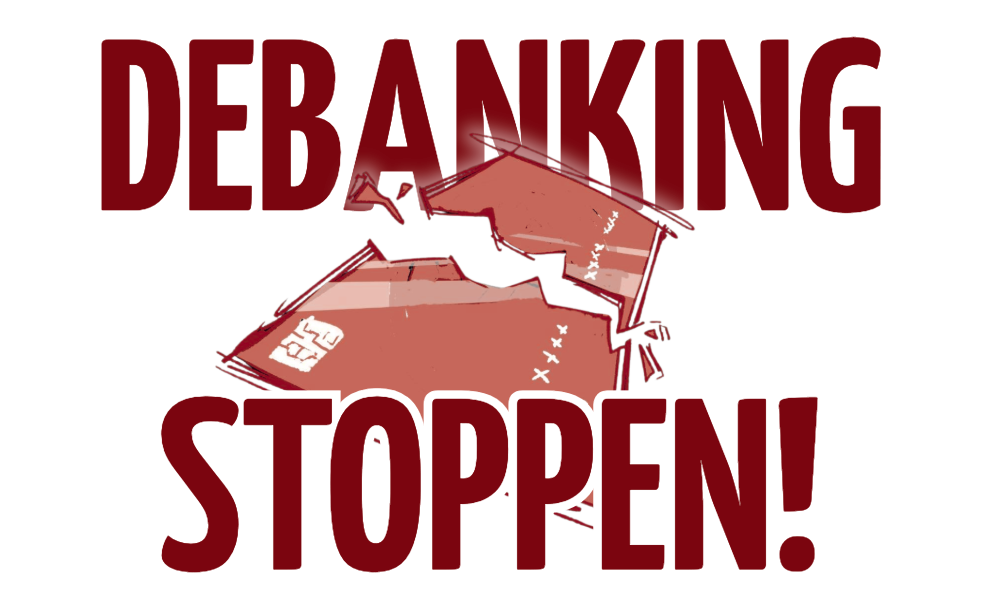
In December 2025, an unprecedented attack on left-wing activism unfolded in Germany: several major banks blocked the accounts of antifascist organisations without providing any explanation.
What happened:
In mid-December, the banks Sparkasse Göttingen and GLS Gemeinschaftsbank informed Germany’s solidarity organisation, Rote Hilfe e.V., that its bank accounts would be closed. The organisation provides legal and financial assistance to left-wing activists subjected to state repression. The move came abruptly and without any objective legal grounds. The banks justified their decisions by citing internal rules and refused to disclose the real reasons, invoking “banking secrecy.”
Reasons for the debanking
Left-wing organisations and activists link this wave of debanking—the denial of access to banking services—to pressure from the United States. In November, the U.S. Office of Foreign Assets Control (OFAC), which administers sanctions policy, added the group Antifa Ost to its list of “foreign terrorist organisations.” Although this designation has no legal force under German law, it has in practice become a basis for banks’ risk assessments — including the risk of sanctions or of losing access to international clearing systems such as SWIFT.
Representatives of Rote Hilfe believe that the banks feared potential repercussions for themselves and therefore terminated their services, even though they were under no legal obligation to do so.
In addition to Rote Hilfe, those affected by this practice include Anarchist Black Cross Dresden (an organisation supporting political prisoners), the Deutsche Kommunistische Partei (DKP), eco-activists from Letzte Generation, as well as left-wing publishing houses such as Mehring Verlag.
Negative consequences
Without bank accounts, left-wing organisations are effectively stripped of the ability to operate. Membership fees, donations, payments to lawyers, rent for premises, and all day-to-day activities run through the banking system. Such measures constitute direct interference in political work and function as a tool of pressure. And while formally nothing is being banned, in practice antifascist and left-wing structures are deprived of their basic infrastructure.
Responses by organisations and forms of resistance
The right-wing turn in Germany confronts the German left-wing movement with a number of crucial tasks that urgently need to be addressed.
We are facing a growing willingness on the part of state authorities to resort to violence and repression against protesters. This became particularly evident in the context of actions in support of Palestine. At the same time, television talk shows and print media are increasingly shaping a landscape of taboo topics, where addressing certain issues is deemed undesirable.
Under these conditions, Germany increasingly falls short of the criterion of democracy as a protected space in which public debate can be conducted calmly and substantively, without tangible negative consequences for one’s personal and professional life.
And this no longer affects only grassroots activists or marginalised groups, but also international actors — including UN officials acting within an official mandate, such as Francesca Albanese — who are facing political and media pressure for carrying out their professional duties.
The German chancellor is also striving to keep pace with the spirit of the times. Alongside numerous inflammatory remarks about migrants and the proclamation of symbolic funerals for the left (“the left is finished”) he chancellor is also resorting to material methods of confrontation. In particular, he is seeking to cut off funding to organisations he considers undesirable.
Today more than ever, stable structures of solidarity are needed. Ones that are ready to fight for the rights of workers and activists.
Activists are currently building the network Debanking Stoppen to coordinate resistance. They are demanding explanations from the banks and a reversal of the decisions. The organisation Rote Hilfe e.V. has filed a lawsuit against Sparkasse Göttingen, seeking to compel the bank to continue providing account services.
However, relying on the courts and bourgeois legal institutions requires a clear-eyed assessment of the kind of trust we place in state and capitalist structures. Whatever their rhetoric or public guarantees, these institutions operate according to the logic of power and capital and can at any moment be steered or overridden through administrative or political pressure.
A viable response lies in building working-class independence, including independent infrastructure. In practical terms it means:
- Collectively defending our interests. No security protocol will protect you from repression without a real collective. A collective is the foundation of real protection: many minds and many hands, ready to step in during any crisis and activate networks of solidarity effectively. But it is crucial to understand that a strong collective is built over years. That is why this work must begin now, before “your house catches fire.” Join us, join trade unions, take part in initiatives not only online, but also in real life.
- Do not trust any bourgeois institutions. This does not mean that they should not be engaged with or used. It simply means assessing the risks soberly and realistically. Use the debanking cases described above as a reference point when making your decisions.
- Distribute material resources and manage them in a decentralised manner. This will protect you not only from attacks by authoritarian states or from arbitrary decisions by platforms and banks, but also from the misappropriation of funds or other morally unstable behaviour by members of the organisation (it happens).
- Diversify your social media presence and media channels. Be prepared for the possibility of being deplatformed at the whim of “very importan person” (X, Facebook, Telegram, etc.).
- Use your own alternative media platforms, messengers, and social networks. In recent years, decentralised protocols and the communication services built on them have been developing rapidly. The more people consciously use alternative social networks (for example, Mastodon), the greater the chance of crossing the network-effect threshold in favour of a decentralised ecosystem. This is about reaching a critical mass of users at which the value of a platform grows with each new participant — and the platform becomes useful precisely because it is used by your own social environment.
- Online and public-space security: do not use your real identity without fully weighing the risks; make use of multiple digital identities.