In periods of political instability, economic crisis, and growing competition in the labor market in capitalist countries, there is always a wave of hostility toward immigrants, especially refugees. They are said to be “prospering at the expense of hard-working locals who earn little.” The argument goes that the authorities should not be supporting “outsiders,” but should instead cut taxes for citizens and businesses and invest the freed-up funds in supposedly “advanced” sectors of the economy, which, it is claimed, would soon improve the lives of the local majority without any need to bring migrants into the country.
Right-wing political forces of varying degrees of radicalism seek to capitalize on such sentiments. Today’s Germany is no exception. Friedrich Merz, first as leader of the Christian Democrats and then as federal chancellor, openly declared his intention to sharply reduce the number of people coming to Germany in search of protection and relatively better living conditions than in their countries of origin. At the same time, he repeatedly and openly called for speeding up the deportation of those whose asylum claims had been rejected.
Interestingly, even a superficial monitoring of social media shows that many right-liberal immigrants and refugees from Russia and the post-Soviet space supported this turn in his party’s politics. It should be noted that Merz did not go as far in his “criticism” of migration as the level of hysteria seen from Trump or Orbán, and formally “only called for compliance with existing laws.” He spoke of the need to reduce incentives for economic migration disguised as a need for protection from persecution, of expelling people who commit serious crimes such as murder, and of the difficulties of integrating into the labor market people from the poorest countries of the Global South, who often lack qualifications in demand in the German economy. This is, in many ways, what explains the stance of the above-mentioned right-liberal public. The implication is that “our” migrants are supposedly more “proper” refugees: they know languages, are highly qualified, cultured, and law-abiding.
In practice, however, it is impossible to quickly reduce the number of refugees and demonstrate visible success to voters without increasing pressure on all migrants, regardless of skin color, country of origin, or qualifications. In 2022–2024, under the so-called “traffic light coalition” (Social Democrats, Greens, and Liberals), the situation was somewhat softer. For example, many Russians were temporarily protected from deportation by the lack of direct flights, shared borders, and the diplomatic rupture. Some even managed to obtain humanitarian visas.
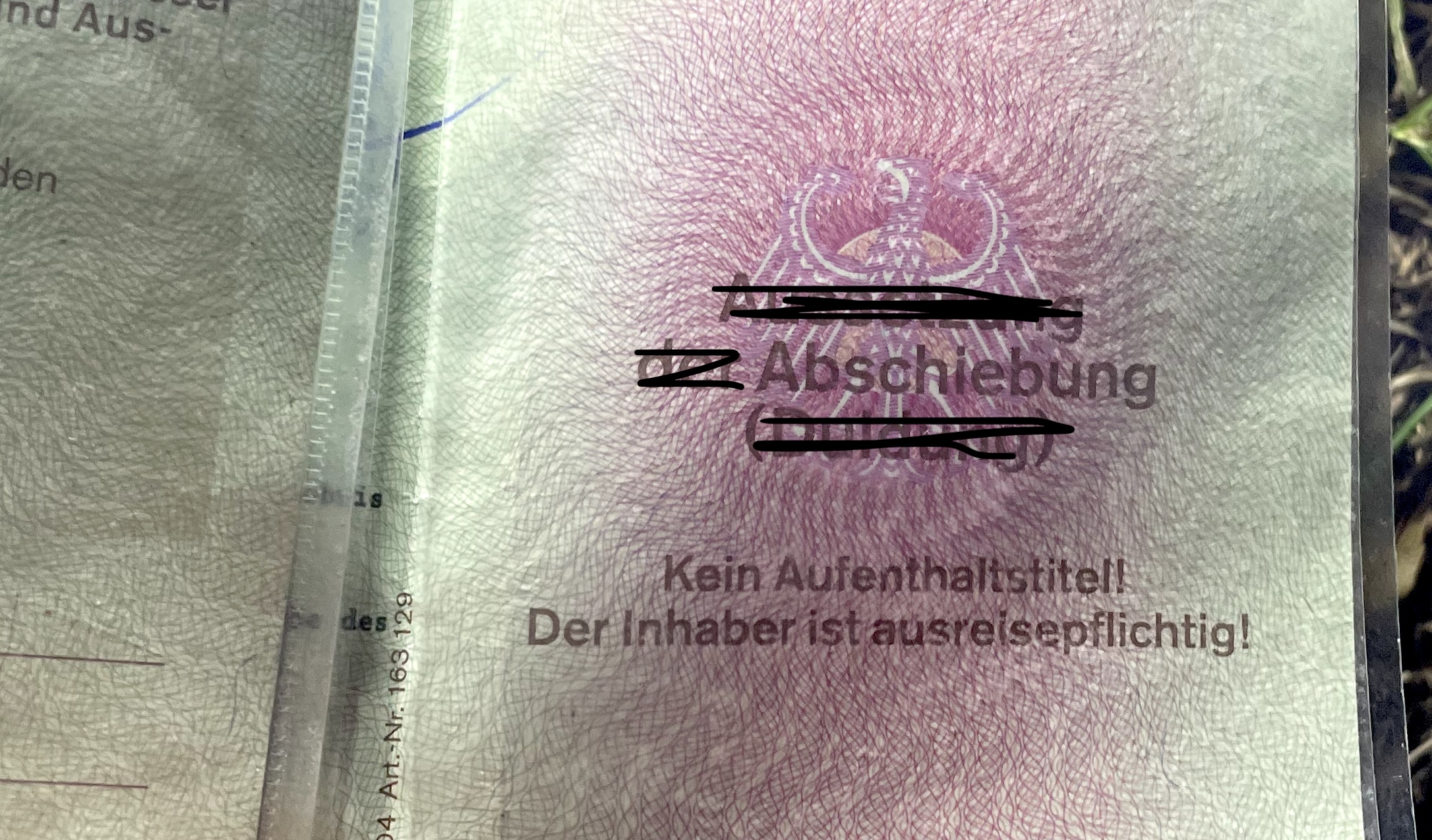
Under Merz, humanitarian visas have effectively been abolished, and deportations are now being carried out through so-called countries “friendly” to Russia, in particular Georgia. LGBTQ activists and Russians facing persecution for donations to organizations labeled “undesirable,” “extremist,” or “terrorist” are also under threat. Let us recall that the share of Russians recognized as needing protection is extremely low: according to BAMF, it has fallen below 7%. This is due in part to the fact that, for reasons unclear to us, the German authorities “believe” Putin’s statements that the “partial mobilization” of 2022 has ended, and treat the absence of a criminal case as a sign that a person can safely return to their “native harbor,” assuming that “things will be sorted out on the ground.”
As a result, we are faced with the following outrageous situation: in an effort to fulfill deportation quotas, the German migration police first secretly check the listed address, posing as postal workers, and then, early in the morning, a black van (a paddy wagon) without markings arrives for the person. The deportee is given 10–15 minutes to pack, their phone is taken away, and they are escorted in handcuffs to the airport or to a detention facility pending deportation.
Thus, in January, the case of draft deserter Georgy Avaliani became known. He had been conscripted, ended up in a torture basement, escaped from the army several times, and is now wanted under an article on desertion that carries a sentence of up to ten years in prison.
Nor is the fate of libertarian Ilya Shkolny surprising in this context. After the start of the invasion of Ukraine, he entered Germany on a tourist visa and applied for political asylum with the help of a German acquaintance. He later married her and enrolled in a master’s program at a Bavarian university. However, despite being married to a German citizen, on March 11 of this year he was arrested by the migration police and placed in a deportation prison.
Of course, the number of high-profile deportations of activists to Russia remains relatively small for now. Last year, for example, there were 111. But even this figure cannot but cause alarm. Not to mention that these are, in effect, the fates of Russian citizens who may face problems with the authorities in their home country. At the same time, we have no doubt that as the crisis deepens and the rightward turn in German politics intensifies, pressure on refugees from Russia, and not only Russia, will continue to grow.
That is why it is already necessary to spread information in the media about cases of unlawful asylum refusals and deportations, and to fight for people’s lives and freedom with the help of non-profit and political organizations and lawyers. But even more important is solidarity among all progressive, left-wing, and democratic immigrant organizations.
If Russians fight only for Russians, Syrians only for Syrians, Afghans only for Afghans, and Ukrainians only for Ukrainians, this will weaken the common action that is so urgently needed and fragment efforts even further, into campaigns to defend only LGBTQ Russians, only Kurdish Yazidis from Syria, only feminists from Afghanistan. We are convinced that all these separate initiatives will be crushed by the soulless bureaucratic machine.
The time has come to unite. Raise high the banner of international solidarity—in Germany, in Europe, and throughout the world. PSL calls on all democratic and left-wing émigré organizations to coordinate their actions. We are ready for dialogue. Reach out to us!