Caolan Robertson, an Irish blogger based in Kyiv with more than a million subscribers, released a video last week: “Russians are heading to the Stone Age”. In March he interviewed Zelensky; in June the president awarded him the Order of Merit, third class, for Journalists’ Day.
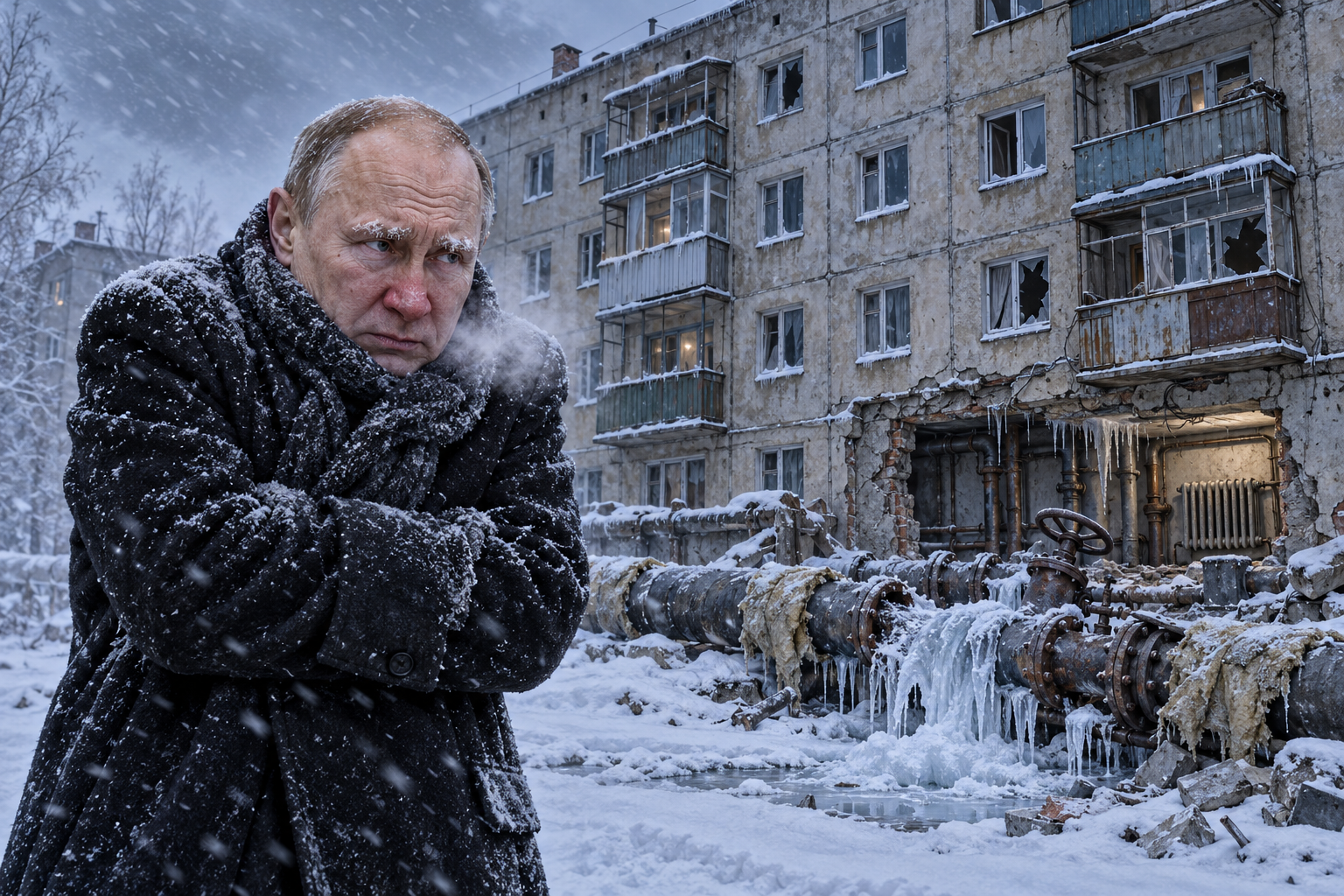
In the video Robertson explains that strikes on Moscow, cut-off heating and “smoke in Muscovites’ lungs” should cure Russians of their appetite for war. He calls this “a good strategy” and a chance for peace.
So where does all this Russian appetite for war come from?
“It’s in Russia’s psychology since Soviet times, since the Cold War: stockpiling and building weapons, it’s just what Russia likes to do. Essentially it’s a symptom of a much deeper cause, and that cause is Russia’s insatiable appetite for war, insatiable appetite for killing. And if you take away that very appetite, then maybe Russians will lose the burning desire to build so many weapons, so many depots, and bomb Ukraine every few minutes.”
So life in Russia has to be made such that people can’t go to the shop or the petrol station, and in the end give up. For this he leans on his own interview. In July Robertson recorded it in the command centre of Robert Brovdi, Madyar. Madyar commands the Unmanned Systems Forces, a separate branch of the Armed Forces of Ukraine, and was appointed to the post by Zelensky’s decree. There he called the Russians a “nation of parasites” that has to be isolated, and the inhabitants of the “sub-country” worms.
For Madyar, worms are a unit of measurement. Every day on his channel, which has 600,000 subscribers, his troops’ report goes out: so many “khrobaky”, that is, worms, killed in the past 24 hours, so many since the start of the month. There is an online scoreboard for the count, called “ПІДРАХУЙКА”, roughly “the Tally”. On 25 September Madyar wrote about the freshly mobilised men now being driven to the front. In his words, this is a new contingent of worms being pulled up to the front ahead of disposal.
Above Madyar in the hierarchy stands the commander-in-chief. On 21 July, the day Madyar’s interview came out, Zelensky appointed Mykhailo Drapatyi commander-in-chief of the Armed Forces. The next day an interview with Drapatyi from 2023 was published, in which he calls Russia “a nation with a leadership that has no right to exist”. Nothing civilised there, he says, has changed in a thousand years, neither the mentality nor the imperial ambitions. In the same interview he explains why there are residents in the Donbas willing to help the Russian army. Historically there were many resettlers there and “criminal elements”, hence a population “lacking consciousness”, poorly Ukrainianised, people who “don’t want to work, they want handouts” and don’t care which country they live in. His cure is upbringing, so that what grows up is “a Ukrainian, and not, excuse me, a belch of the Soviet Union”.
Let’s take a closer look at Robertson’s theses. They merely repeat the views of part of the Ukrainian military and officialdom, from Madyar and Drapatyi to Danilov; of European politicians like Kaja Kallas and Gabrielius Landsbergis, who closed the borders to Russians; and of some of the “good Russians” abroad who gloated when the Wildberries warehouses burned. Robertson himself admits that Ukraine has lived through four winters of strikes on its power grid and has not surrendered. Why should it be any different with Russia? Russians, he says, are “psychologically not ready”.
Next. Robertson calls Russia a dictatorship that doesn’t care about its citizens. Then why freeze them? If a pensioner in a Moscow panel block could stop the war, Russia would not be a dictatorship. And if she can’t, her suffering decides nothing. Putin, after all, isn’t freezing.
And one more thing. Robertson rightly calls Russian strikes on Ukrainian cities terror. The same strikes on Russian cities he calls “strategy”. He calmly explains that Russians must be collectively punished for being… Russians.
In 1941–1944 the NKVD deported entire peoples to Kazakhstan and Siberia by ethnicity, communists and frontline soldiers included, from the Volga Germans to the Crimean Tatars. After the war, Poland, Czechoslovakia and their neighbours, with the Allies’ consent, expelled 12–14 million Germans. The United States, by Roosevelt’s order, locked 120,000 Japanese in camps, two thirds of them American citizens. And Hitler in *Mein Kampf* called the Jews parasites in the body of other peoples. Both the USSR and the US later admitted themselves that this cannot be done. Robertson hasn’t reached that conclusion yet.
Robertson once made viral videos for Tommy Robinson, the British far-right activist and founder of the English Defence League. The enemy there was Muslims. Today he calls it propaganda and says he regrets it. But it seems to be “in his psychology”, going back to those days.
For years the Kremlin has been telling Russians that there are Nazis across the front line and that the West hates everything Russian. Madyar and Robertson give the Kremlin its best quotes. The “nation of parasites” interview could run on Channel One without a single cut. A Muscovite who has been told he is a parasite and has to freeze will presumably be deeply moved and carry the white-blue-white flag of the “good Russian” onto Red Square.
At the end of his July interview Madyar explains: the population of all of Russia has to be filled with horror, so that everyone thinks twice about signing a contract for a few million roubles. Fine, he thought twice. He didn’t sign the contract, didn’t take the summons. Now the enlistment office is looking for him, and staying in Russia is dangerous. What happens to him next? In September 2022, the day after mobilisation was announced, Zelensky himself called on Russians: “Protest. Fight back. Run away. Or surrender to Ukrainian captivity.” Six weeks earlier he had demanded that the West close its borders to all Russians. Kuleba, foreign minister at the time, explained that almost all Russians support the war and don’t deserve the right to cross borders. The EU suspended its visa facilitation agreement on 12 September 2022, nine days before the mobilisation, and has only kept tightening the screws since. So: run away. But there is nowhere to run. A closed border does more for the Russian enlistment office than Channel One.
To be fair, there were attempts in Ukraine to tone down the dehumanisation of the enemy. In May 2024 the National Council of Television and Radio Broadcasting asked journalists not to call Russian soldiers “orcs” and “rusnia”. Such words, in the Council’s view, stir up hatred towards all citizens of the aggressor state. Nine days later the document was taken down from the website. The explanation: Russian channels had made use of it. The warning against dehumanisation was withdrawn because the enemy was quoting it. Madyar’s report, the enemy can quote every day.